

Cycling and Hiking Shikoku’s 88 temple pilgrimage route in Japan: Temples 22 – 51
The pilgrim’s ordeal
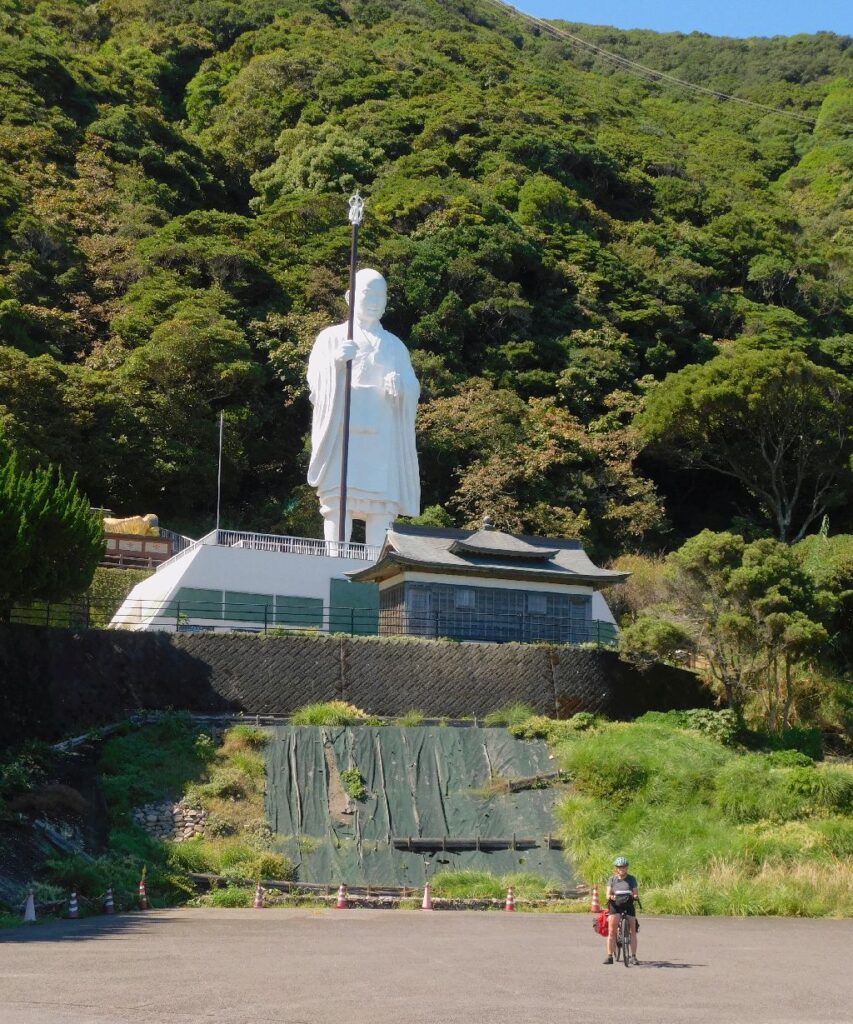
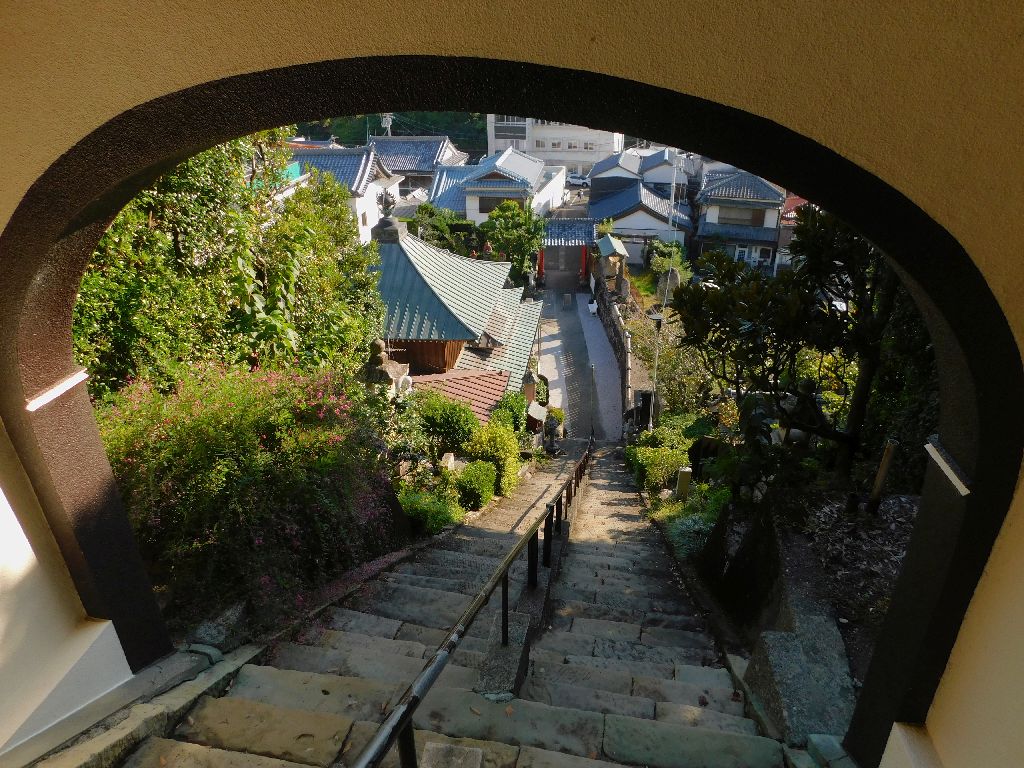
I stood, weak and dizzy, at the foot of the steep stone stairway to the grey tiled temple of Ishiteji, the 51st temple on the ancient Buddhist pilgrimage around the lush, mountainous island of Shikoku, Japan. ‘What was I thinking?’ I gritted my teeth, wiping sweat off my brow as I hobbled painfully up the uneven steps to the temple. ‘Why did I ever think that bicycling and hiking the Henro Michi pilgrimage would be a great idea?’ I mumbled miserably.
At the top of the steps, I peered into the latticed wooden windows partially concealing a dimly lit statue of the Buddha surrounded by twinkling golden lanterns. Below me, a large stone incense bowl wafted smoke from the three sticks I had lit in honor of our visit. I shoved a clammy hand into the pocket of my white henro (pilgrim) shirt. Down the back of my shirt, the words written in Japanese proclaimed, “Two traveling together,” referring to the belief that pilgrims were always accompanied by the spirit of Kobo Daishi, the founder of Shingon Buddhism.
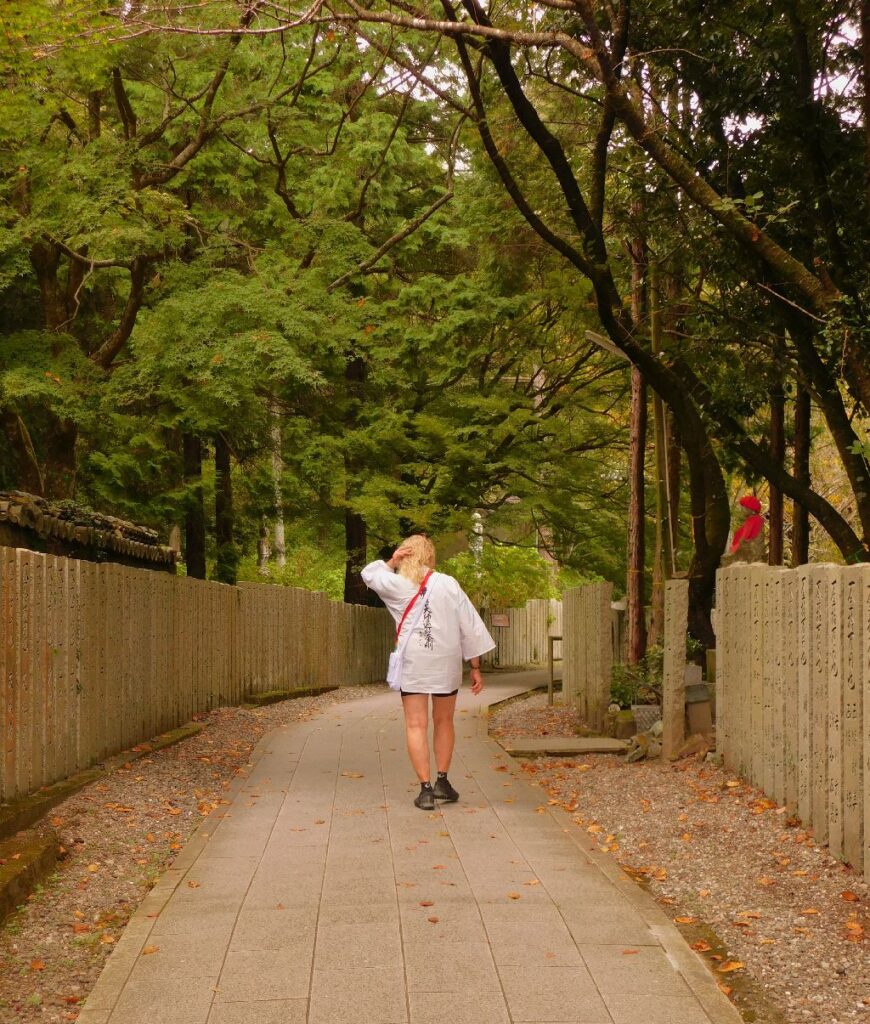
At this moment, I truly doubted that Kobo Daishi–the famous eighth century monk credited with establishing the eighty-eight temples on this pilgrimage—was traveling with me. In fact, as I felt around in my pocket to find my pilgrim blessing nameslip, or osame fuda, I was beginning to wonder if the revered monk was deliberately hindering our journey.
A few days earlier, my husband, Lorenz, had even jokingly asked me what I had done to offend the Buddhist/Shinto deities?[i] For the past week I had been battling food poisoning while trying to cycle from temple to temple along Shikoku’s rugged and empty southern coastline. I had pulled a tendon in the back of my knee and was limping. And a big hard red welt on my right arm reminded me of the giant Asian hornet that had stung me as I hiked up the steep trail to Temple 20.
‘How had it come to this?’
We had been so excited during our first days as new henros starting out in the bustling port city of Tokushima. Sharing our adventures with new pilgrims from all over the world, we nervously bowed at the imposing gates to the first temples, trying to follow the unfamiliar pilgrim rituals. We spent our nights in traditional silver-tile-roofed guesthouses. Ate lunch from beautiful bento boxes bought at large, clean, shiny supermarkets. And stopped for dinner at the many bustling Japanese noodle houses along the way. The pilgrimage had seemed easy, even fun. Looking back, I could see that we had been lulled into complacency, pedaling and hiking up and down the relatively flat, easy and populated valleys of the Yoshino and Akui Rivers, only briefly daring to face the challenge of the surrounding lush mountains.
Abruptly, at Temples 20 and 21, the generally flat route ended. Without warning, a giant Asian hornet stung me as we had paused on our steep hike up to Kakurunji Temple, my arm swelling red and hard with the sometimes fatal poison. Suddenly, the roads, punctuated by bobbing conical pilgrim hats and the tapping staffs of white robed pilgrims, became long and empty. Many walking pilgrims wisely finished their journey here, satisfied with hiking the first 120 kilometers and ending at the otherworldly, beautiful mountainous Tairyuji, Temple 21. Most of the remaining walking pilgrims, looking at the hundreds of kilometers of desolate highway stretches ahead, began taking buses to cut out the long, empty sections between temples.
After Tairyuiji Temple, even the weather turned against us, as we headed into the wettest region of the entire country. The next morning, the skies opened up on us, pouring down with heavy, drenching rain. Over the next few days, we became wet, soggy messes, arriving at the pilgrim guesthouses dripping on the doorsteps as the kindly Japanese owners directed us to their showers and washing machines. Somewhere in the storms, my phone became waterlogged and died. ‘How foolish we were to depend on electronics!’ I grumbled, as Lorenz and I spent an hour in the rain wandering around the beach town of Shishiskui trying to remember the name and location of our guesthouse, now lost inside the fried phone.
I did not see then, that the pilgrimage was stripping us of our attachments. To technology, to physical comfort, even to our fellow pilgrims, who we only saw at the temples now. And occasionally at night in the humble, country guesthouses, where we slept on the floor on reed tatami mats, meeting each other bleary-eyed in the morning in the shared bathrooms.


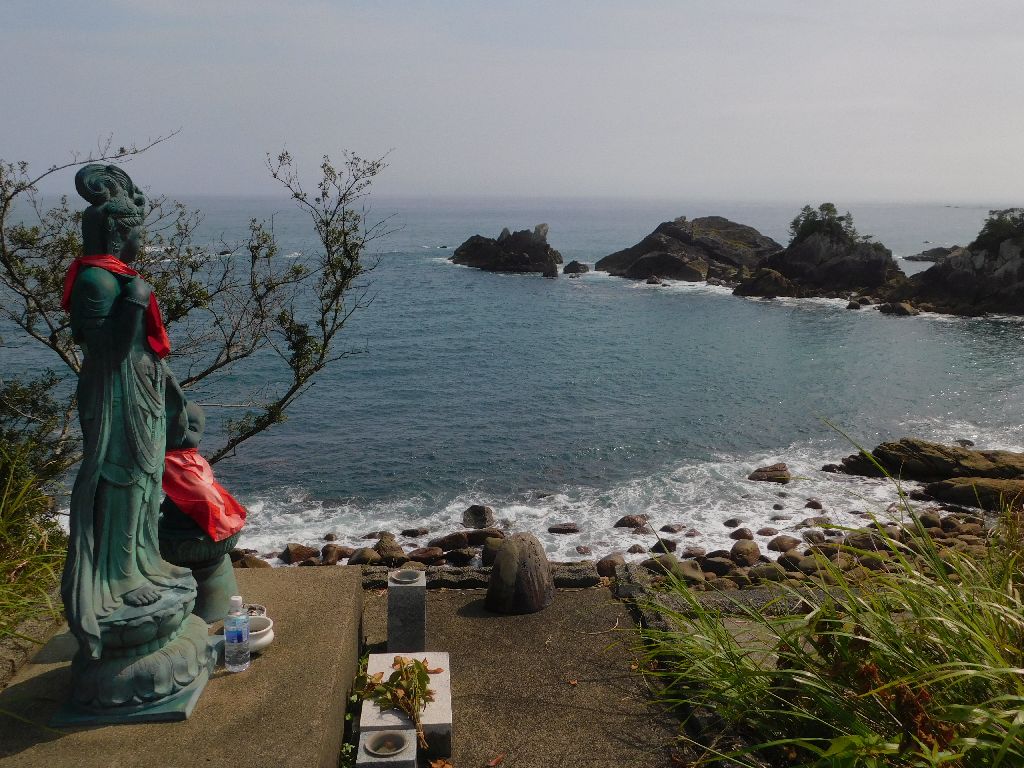
But oh, how beautiful the route along the empty windswept coastline to Cape Muroto was! I felt almost sorry for the other pilgrims who were whizzing past us on the buses, glimpsing this beauty only for an hour or two from the dusty windows. Lone pilgrims pedaling along the highway, Lorenz and I wended past stunning seastacks, silent rocky beaches, tiny fishing villages and empty gravel coves. At the wild, windy cape, we visited dank, dark, mysterious Mikurodo Cave where Kobo Daishi achieved enlightenment. Then, locking up our bikes, we hiked up the steep trail to Hotsumisakiji, Temple 24, perched on the cliffs by the lighthouse warning sailors of the jagged rocks beneath us. Gazing at the breathtaking view below, little did I know that our pilgrimage trials were far from over!
The next day, I limped out of our guesthouse, the back of my knee screaming at me. ‘I must have pulled a tendon on the way down from Temple 24,’ I groaned. ‘Hopefully, it was just a minor injury, one that would calm down soon,’ I lied to myself. Surprisingly, I could still pedal on my bike. And so, Lorenz and I continued on. Cycling with a sore, red arm from the hornet sting, and hobbling up the stairs to each temple, I must have been a sight.
I was not alone in my misery. Starting at Temple 21, the injured pilgrims increased each day. First was a tall, strong, red-haired man who stumbled into our hotel looking half dead as he returned from the famed henro korogashi (knock down pilgrim) trail to Tairyuji Temple. Then at the hostel in Hiwasa, we met a Swedish woman, whose hip and knees were in such pain, she had stopped her trip to visit an acupuncturist. At the Geothermal Park Museum bus stop, near Cape Muroto, a young Russian pilgrim stumbled off the bus, dazed, wobbling and ready to faint from heat exhaustion. As I limped up to each temple, I was now joined by other pilgrims wearing black knee braces; hobbling on their pilgrim sticks; sweating profusely and hiding on benches in the shade from the intense, humid October heat and sun.
I should have realized then, that this pilgrimage was a serious ordeal, far, far removed from my idealized fantasies of a peaceful month of quiet meditative days biking and hiking between fairytale temples: a Buddhist style yoga-on-the-beach retreat in Japan. How naïve I had been! No– pilgrimages around the world have always been perilous journeys fraught with dangers. Christians and Jews heading on the sacred journey to Jerusalem risked sinking at sea on leaky ships. Catholic pilgrims on the caminos of Europe feared attacks by robbers on the trail, Muslims on the haj faced dehydration and death wandering through the desert. And suffering from disease and dysentery was expected for everyone—perhaps even hoped for. Poof of one’s faith and devotion. Why should I, or anyone else, be exempt from the physical challenges of the pilgrimage today? The mountains were the same. The temples had not moved.
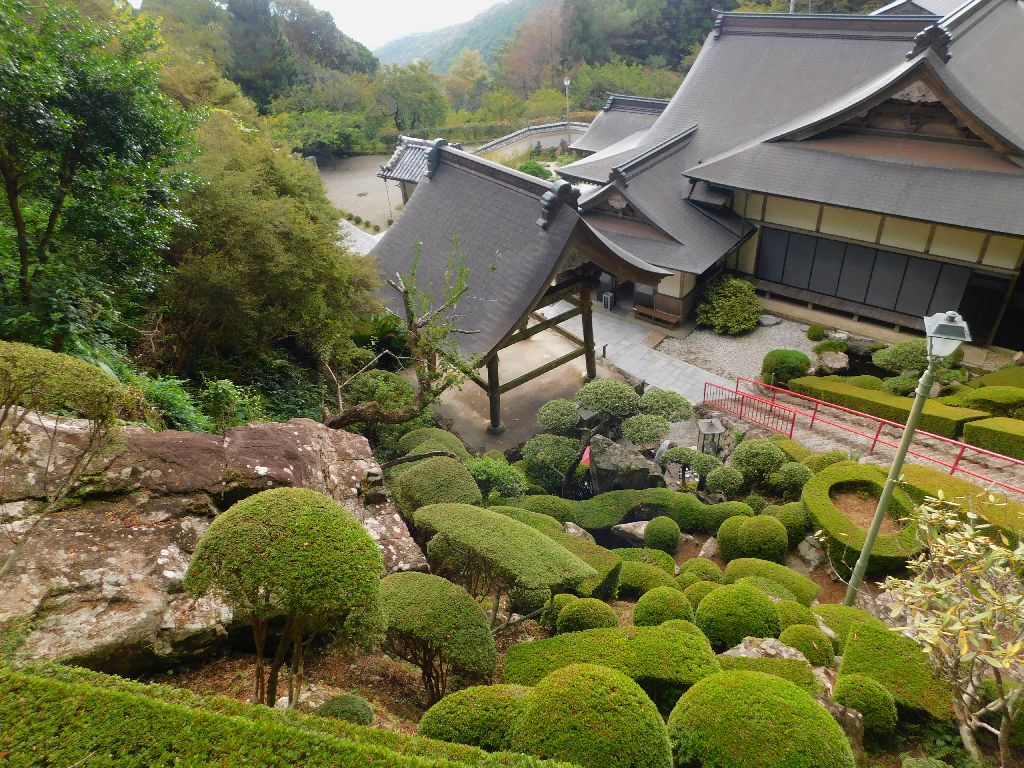
At Konomineji, Temple 27, the fourth henro korogashi temple, it was obvious that I was unable to hike up the steep 1,400 foot climb to the cascading mountaintop temple. I, too, had become a knocked-down pilgrim! Seeing our plight, our voluble and chatty guesthouse owner drove us up to the top of the mountain, past tier upon tier of beautiful gardens, carved stone shrines and wooden temples tucked among the manicured bushes and graceful trees. How kind the Japanese were to us in so many ways! Giving us cold drinks, candies and little amulets to protect us on the way, as they offered us settai—a unique Buddhist practice of helping Shikoku pilgrims on the Henro Michi.
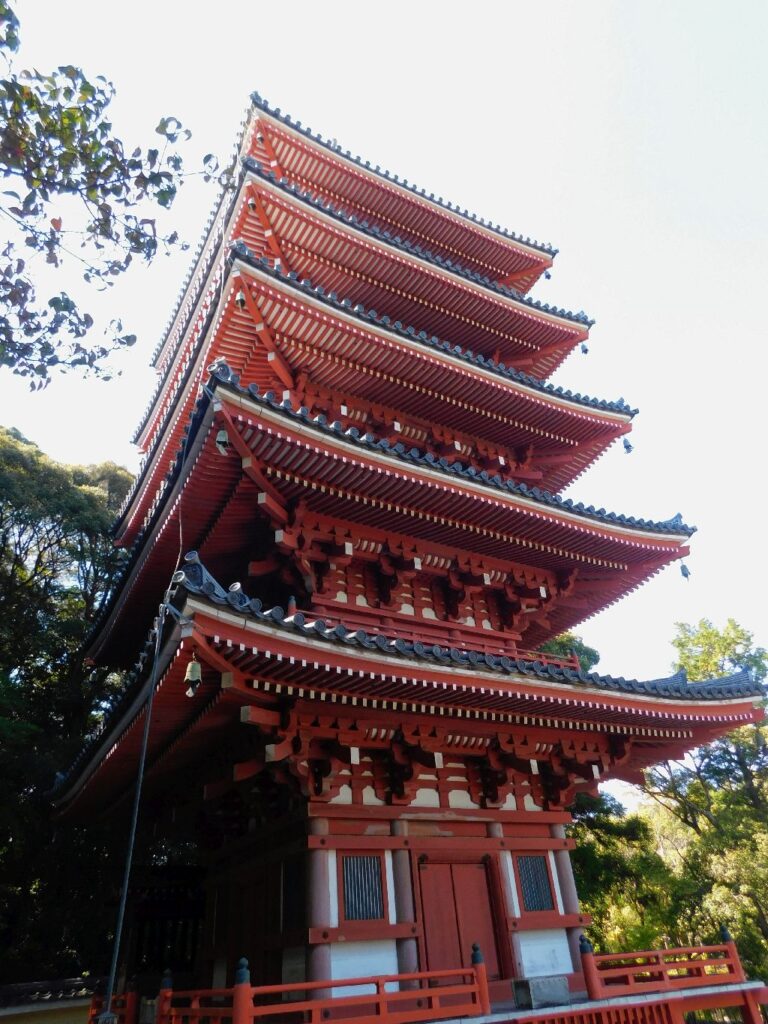
By the time we reached the bustling southern city of Kochi, I was desperate for a few days’ rest in a modern hotel. Thinking only of a soft western bed and air conditioning, I moved mechanically through the rituals at Temples 28 and 29. As we sat in the shade to cool down from the 85 degree heat, I choked down the warm fish sushi we had been carrying all day in our bento boxes. Unexpectedly, for one lovely moment, at Temple 31, Chikurinji, I forgot all the challenges of the previous week. In awe, we wandered the lush gardens of the hilltop temple complex with its exquisitely carved, pink, five-storey pagoda. Surely, my leg and arm must heal soon!
But the Japanese Buddhist/Shinto gods, it seemed, had other plans for me. I was not going to pass through the challenging ascetic training of a pilgrim so easily. The next morning in our modern Japanese business hotel, I woke up to three hours of nonstop diarrhea. Oh no! Food poisoning in modern, squeaky clean Japan? I thought back ruefully to the tepid bento box of fish sushi. How stupid could I be? I spent that night, back at our hotel, sweating and tossing with a terrible fever, the dysentery continuing with a vengeance.
I remember only snippets of the following week. Forced to leave Kochi, since all hotels were fully booked due to the National Sports holiday weekend, we conceded defeat, put our bikes on a train and headed to the only guesthouse we could find, further south down the coast on the way to Cape Ashizuri. Certain that I only had a short-lived bout of travelers’ misery, we continued pedaling farther and farther away from medical care.


We cycled past quaint fishing villages, boats clanking in the wind on their moorings. Along lush, green river valleys, peppered with traditional silver-tile-roofed homes with beautiful carved waterspouts. Up and down jagged coastlines and over steep, winding passes with stunning views of the islands in the ocean below. In this lush, mountainous and sparsely populated corner of Japan, we ate almost all our meals from the occasional Lawsons or 7-11 convenience stores on the way. Food mattered little to me, since I was living primarily on Pocari Sweat (a Japanese Gatorade)–bought ice cold in the ubiquitous Japanese vending machines. But Lorenz struggled to find enough calories, while also caring for me, as I became sicker and more exhausted each day, with no sign of improvement.
“We need to get to a doctor! Now!” he argued as I lay, miserable and in pain, on our futon bed in a guesthouse in the fishing town of Sumako. “If we can make it to Uwajima today, we can catch a train to Matsuyama tomorrow morning.”
I knew he was right. I needed medical care and Matsuyama was the largest city in Shikoku. But to get to Uwajima, we would have to pedal seventy kilometers and climb over numerous steep headlands, including a precipitous thousand foot ridge. In my weakened state, I didn’t think I could do it.
“I’ve found a shortcut along the ocean,” he cajoled. “You can make it!”


A few hours later, we stood in shock, staring at a steep, winding track, covered in branches, leaves and debris. I doubted anyone had driven through here in months. “This is your shortcut???” I glared at Lorenz, wanting to scream. I can’t remember how I wobbled up that mountain ridge. But I’ll never forget the breathtaking views of the green, jagged, uninhabited islands below, the ocean glistening in the sun as we climbed. Or the exquisite string of remote tiny, Japanese fishing villages, clustered along a steep mountainous fjord as we whizzed down the other side. For the next forty kilometers, Lorenz cajoled, admonished and begged me to continue up over endless headlands Finally, an hour after sunset, I fell, completely drained, into a soft, clean, Western bed in a hotel right at the train station in Uwajima.
************************
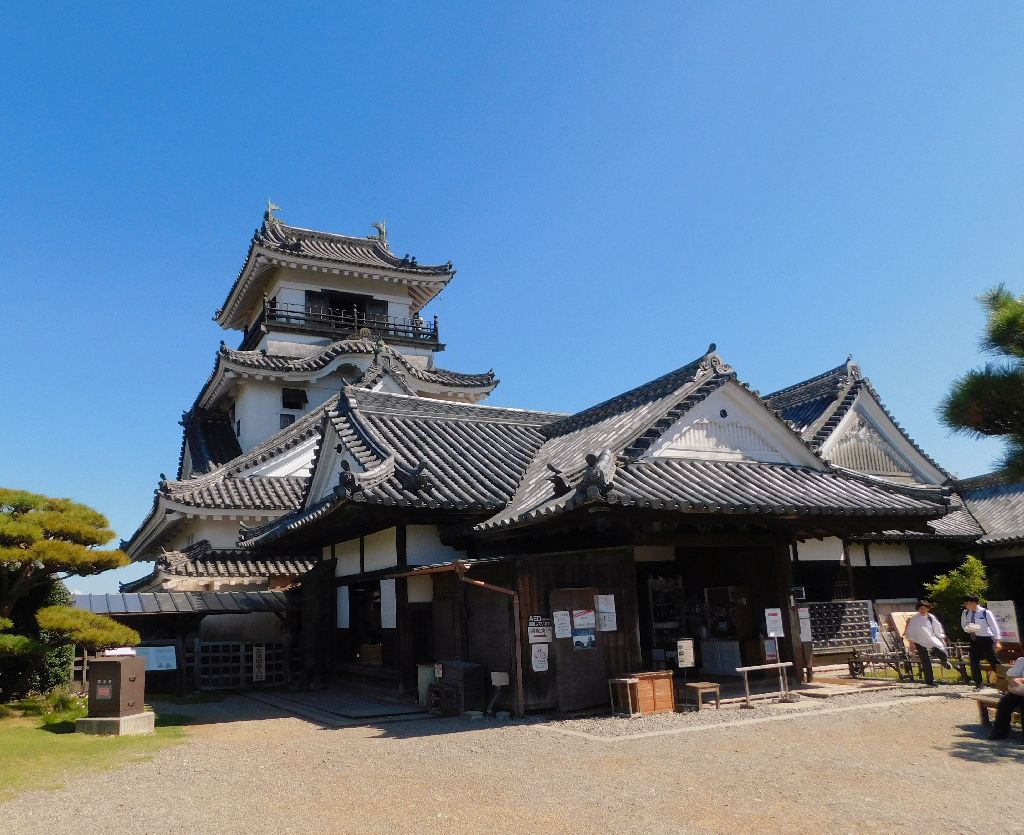
Two days later, fortified with antibiotics after visiting the doctor, I stood in front of the wooden lattice windows of Temple 51, Ishteji, in Matsuyama. For over 1,300 years, pilgrims before us had walked on the stone pathways of this ancient temple, coming to ask for protection, for help in solving their problems, for guidance and wisdom. Shaking myself from my reflections upon the past few weeks, I reached in my pocket for the osame fuda blessing slip, and reread my prayer: I ask for help to finish this pilgrimage. Next to me, I could hear the hauntingly beautiful, murmured prayers of two devout Japanese pilgrims reciting the heart sutra. I threw the little white piece of paper with my wishes into the silver box.
“I have sorely underestimated this pilgrimage,” I admitted humbly, as I bowed before the temple.
“And yet, perhaps I have also underestimated myself,” I mused. Despite all of our mishaps, we had managed to bike 536 kilometers–and hike well over another hundred–halfway around Shikoku so far.
“I am still here,” I whispered to the statue of the Buddha, silent and mysterious behind the wooden lattice window, “I am still on this pilgrimage.”
And, in the end, maybe that was good enough.
To be continued……
[i] Technically, there are no individual deities in Buddhism. But in Japan, Shintoism—a religion that believes in the inherent spirits of the surrounding world—is blended with Buddhism, so that they do worship specific deities at each temple.
Follow us on Instagram @bike4breath or sign up for our blog at https://bike4breath.com/contact-us/. You might also enjoy reading our book, Breathtaking: How one family cycled around the world for clean air and asthma about our family’s cycling adventures around the world–through 24 countries across Europe, Asia, the South Pacific and North America.